


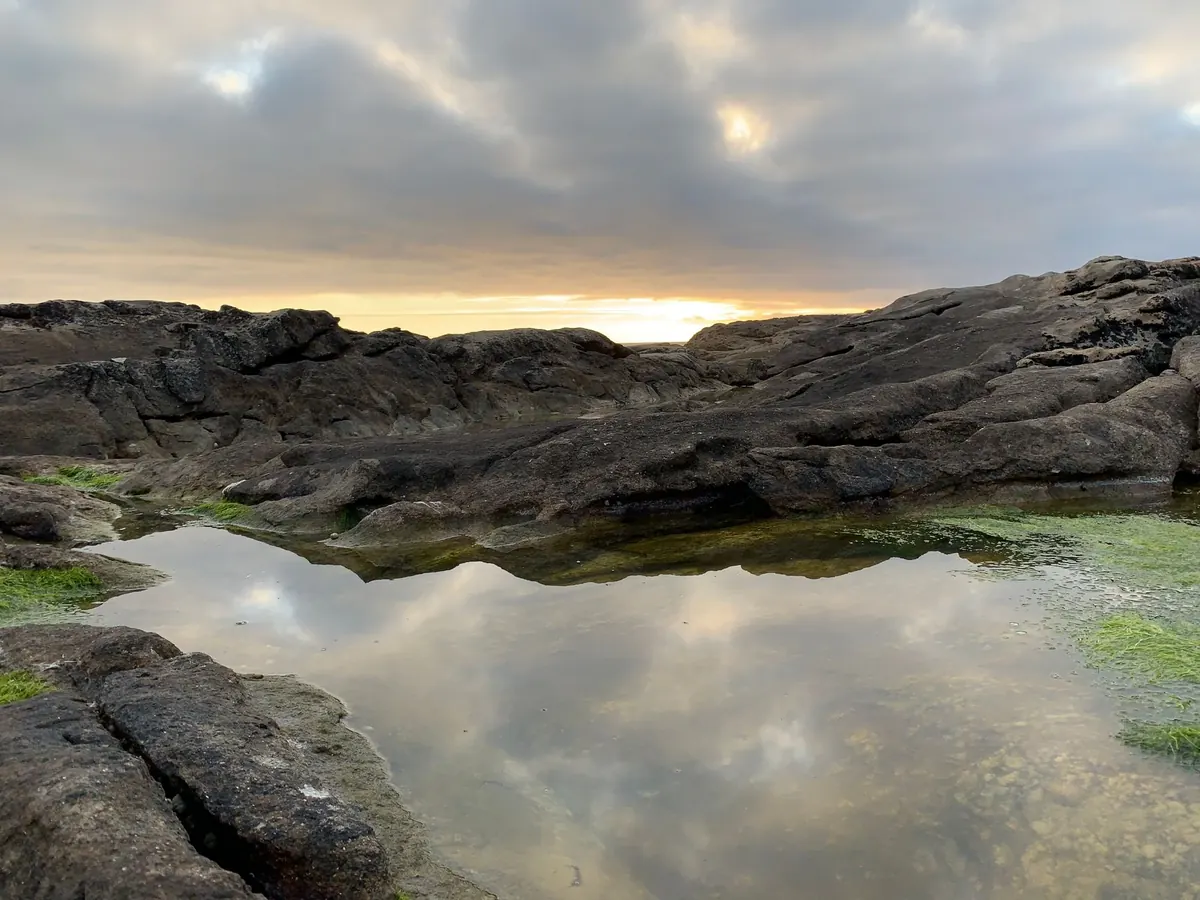
A good rock pool is a small, busy world, and Cornwall has thousands of them. On a bright low tide at Trevone or Porthcurno you can crouch over a patch of water the size of a dinner plate and watch beadlet anemones open like tiny red flowers, a blenny flick sideways into a crack, and a hermit crab drag its borrowed shell across the weed. It costs nothing, suits almost any age, and tends to be the part of the holiday children talk about afterwards. It also goes wrong quickly if you get the tide, the footwear or the handling wrong. Here is how to do it properly.
Read the Tide Before You Choose Your Pool
Rock pooling happens at low water, and nowhere else. Get the tide times the day before — harbour offices, the local tide table pinned up in a beach café, or a reliable tide app you have already checked against a printed table. In Cornwall the tide can move a long way in an hour, and the best pools are the ones furthest out, which means they are also the first to go under.
Two details matter more than the rest. First, tide times shift later by roughly fifty minutes each day, so a perfect afternoon becomes a late evening within a week. Second, aim for a spring tide if the calendar allows: the extra range exposes rock that stays covered on a neap. Spring tides also rise faster, so set a turn-back time about ninety minutes after low water and stick to it. No "one more pool".
Pick a calm, dry day. Onshore wind and swell wash over low rocks and turn clear pools into grey soup, and wet rock becomes genuinely treacherous underfoot. Check the swell forecast with the same seriousness as the tide.
The Kit List
You need less than you think, but the right less.
- Footwear with grip. Wellies with proper tread or old trainers. Flip-flops, bare feet and smooth-soled sandals are how a good afternoon ends early.
- A clear tub or a white tray instead of a deep bucket. You can see straight through a shallow tray, and the creatures stay cooler.
- A small soft-mesh net and a plastic spoon or soft paintbrush for moving things gently.
- A magnifying glass. This is the single item that holds a child's attention longest.
- A towel and dry socks per person, left at the top of the beach.
- Water, snacks, suncream and hats. There is little shade on a low-tide shore.
- A small first-aid kit: plasters, antiseptic wipes, tweezers.
- A phone in a waterproof pouch with a screenshot of the tide times in case signal disappears.
- A folding guide or offline identification app. Naming what you find turns a scramble into a project.
Safety Checks Before Anyone Steps on the Rocks
Run through this out loud, every trip. It takes two minutes.
- Tell someone where you are going and when you expect to be back.
- Look up before you look down. Identify the path off the beach and check nothing is between you and it.
- Never turn your back on the sea. On a bigger swell, keep children above the wave line rather than at the water's edge.
- Agree who is watching what. One adult watches the water, one watches the children. Say it out loud so it is not assumed.
- Set a boundary — "no further than that big rock" — and hold it.
- Test every rock before you put weight on it, and walk flat-footed. Wet green weed on slate behaves like ice.
- Cover cuts and grazes, and wash or sanitise hands before anyone eats.
- Do not touch jellyfish, sea urchins or small buried fish. In shallow sandy areas, shuffle your feet instead of wading barefoot. If anyone is stung or injured and it looks anything other than trivial, seek medical advice rather than relying on beach folklore.
What You Will Probably Find
Anemones, crabs and the usual crowd
Beadlet anemones look like dark red blobs out of water and open into a ring of tentacles when submerged. Snakelocks anemones, green with purple-tipped tentacles, prefer deeper pools with weed. Shore crabs and velvet swimming crabs tuck into crevices; hermit crabs rattle around in stolen periwinkle shells. Look for common prawns, limpets, periwinkles, dog whelks, topshells, mussels and barnacles — barnacles are worth a magnifier, since each little volcano is a small crustacean lying on its back.
Small fish
Common blennies, gobies and juvenile pollock are the standard catch. If you find a small, blue-spotted fish with a sucker on its belly, you have met a Cornish sucker — a genuinely local claim to fame in a rock pool.
Shells, egg cases and oddities
Cuttlebone, the empty egg cases of rays and dogfish known as mermaid's purses, and the knobbly whelk egg cases nicknamed sea wash balls all wash up on Cornish strands. Brittlestars and cushion starfish turn up under stones, along with sponges, sea squirts and the occasional sea slug. Empty shells are fair game for a collection; anything with something living inside is not.
Handling Creatures Without Harming Them
The aim is to look, learn and put everything back exactly as you found it.
- Wet your hands before touching an anemone, or better, do not touch it at all.
- Lift stones and put them back the same way up, in the same spot. Everything living underneath depends on that surface staying dark and damp.
- Keep your catch in a shallow tray of sea water, in the shade, one or two creatures at a time. Never mix a predator with its lunch.
- Return everything to the pool you took it from within about fifteen minutes.
- Leave limpets alone. They grind a home scar into the rock and rarely reattach properly.
- Take nothing home alive. A photograph lasts longer than a bucket of seawater on a car journey, and local byelaws and protected areas vary — if you are unsure about any collection rules, check with the harbour office or the signage at the beach.
Packing Up and Heading Home
Before you climb back up, do a slow sweep of the area: fill in any holes, replace weed you have moved, and check your trays and buckets for stragglers before they go in the car. Pick up any fishing line you see — it is the single most damaging thing left on a Cornish shore, and hooks in a bare foot are a miserable end to a holiday. Leave the pool as you found it and it will be just as full next summer. Then get the wet boots off, find a pasty, and start planning tomorrow's low tide.
Photo: Sergei Gussev / Pexels
Related posts
More stories you’ll love reading