


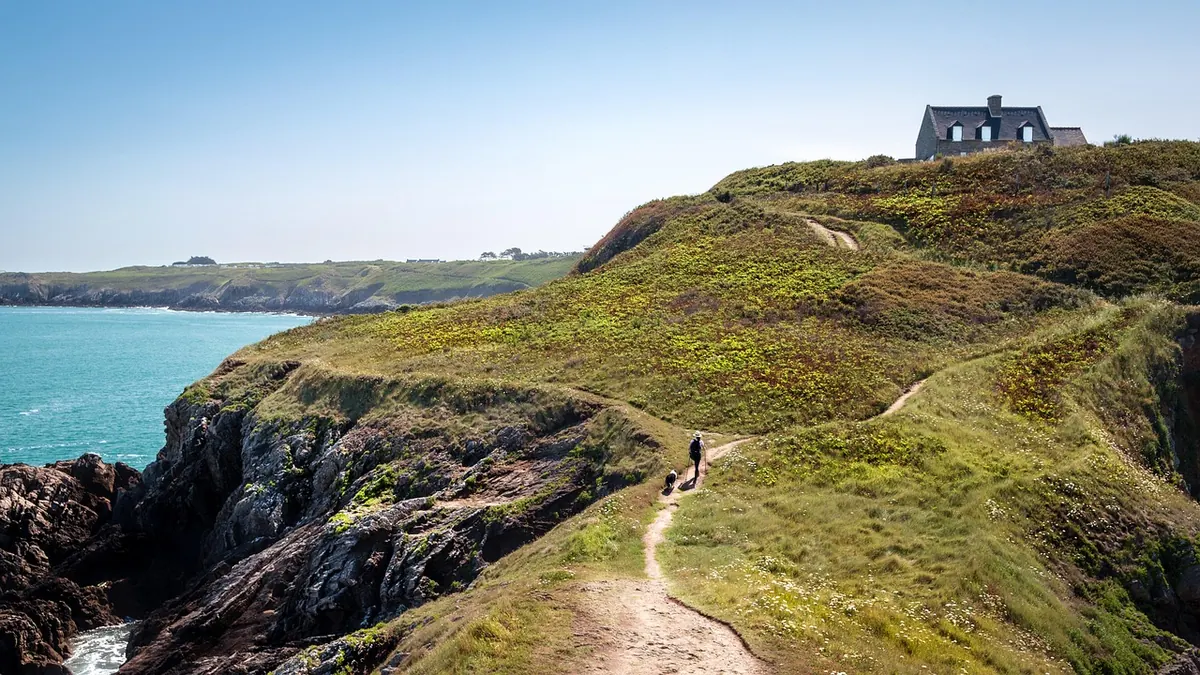
The South West Coast Path runs for 630 miles, and a good chunk of it is in Cornwall. Seeing the whole thing in a week is not going to happen. What you can do is walk one honest, satisfying stretch: a section that starts and ends near a railway station, keeps a village or a pub within a few miles, and never asks more of you than a solid day's walking. Padstow to St Ives is that stretch — around sixty miles along the north coast, seven stages, and public transport never far behind.
Why Padstow to St Ives Works for a First Week
Head south-west out of Padstow and the north coast gives you its best: the Camel estuary, the Seven Bays beaches, the dunes at Penhale, the old mining cliffs around St Agnes, the long sand at Gwithian, and a finish on the harbour at St Ives.
It is also honest about what the coast path is. This is no promenade. The north coast is a sawtooth of short, steep climbs, often three or four in a single mile, on rough and uneven ground. Ten miles here takes most people four to five hours of walking before you count any stops. Plan for that and the week feels generous. Plan for three miles an hour and it feels like a punishment.
The Seven Days, Stage by Stage
Distances are approximate. The coast path is regularly longer than the map suggests, and every stage below has a bus or a station as an escape route.
Day 1: Padstow to Porthcothan — around 12 miles
Out of the harbour, up over the headland at Stepper Point, then Trevone, Harlyn, Constantine Bay and Treyarnon. The toughest opening day of the week. If it bites, stop at Harlyn, roughly seven miles, and bus back.
Day 2: Porthcothan to Newquay — around 9 miles
Bedruthan Steps, Mawgan Porth and the long sweep of Watergate Bay, then over Trevelgue Head into Newquay. The steps down to the beach at Bedruthan are steep and not always open, so check locally before planning to descend.
Day 3: Newquay to Perranporth — around 11 miles
You begin by crossing the Gannel, then it is Crantock, the dunes at Penhale, Holywell Bay and on to Perranporth. Exposed and sandy, so it feels longer than eleven miles.
Day 4: Perranporth to St Agnes — around 5 miles
Deliberately short. Cliffs, the old tin workings above Trevellas, then down into Trevaunance Cove. Use the afternoon for the beach, or take a bus into Truro. This is the day that rescues the week if you are nursing a blister.
Day 5: St Agnes to Portreath — around 9 miles
Across the mining ground above Porthtowan and on to Portreath. Undulating, with two or three sharp pulls, but the views back along the coast are worth the pauses.
Day 6: Portreath to Hayle — around 11 miles
Gwithian dunes and Godrevy, then the Towans into Hayle. Flatter than earlier days, but sand underfoot is tiring in a different way, and the beach at Godrevy is not the place to be caught by a pushing tide.
Day 7: Hayle to St Ives — around 6 miles
Along the estuary to Lelant, over the low hill to Carbis Bay, and into St Ives past Porthminster. Finish with a pint on the harbour, then take the branch line from St Ives to St Erth. It is one of the prettiest short train journeys in the country and the easiest possible way home.
Trains, Buses and Getting Back Again
Padstow has no railway station. Most walkers arrive by bus from Bodmin Parkway or Wadebridge, or drive and leave the car for the week. Check current timetables before you commit, because services change with the seasons.
At the other end, St Ives sits on the branch line to St Erth and the mainline. Mid-route, Newquay, Hayle and St Erth all have stations, and Truro is a short bus ride from Perranporth and St Agnes. First Kernow runs the coastal services, including the Atlantic Coaster between Newquay and Padstow. Summer timetables are decent; winter ones are thin, and some routes finish early in the evening. Know your last bus before you set off in the morning.
Tides and the Crossings That Catch People Out
One crossing really matters here: the Gannel, between Newquay and Crantock. The Fern Pit ferry runs seasonally and only on certain states of the tide. If it is not running, the alternative is a detour inland to the bridge at Trevemper, which adds a couple of miles. Ask at your accommodation the night before.
If you are walking in from the north, the Padstow to Rock ferry across the Camel is the other one to check, as it keeps limited hours. Otherwise the rule is simple: never let a shortcut across sand decide your day. The route is waymarked with acorn signs, and the official path is almost always the safe one.
Pub Stops Worth Timing Your Day Around
North Cornwall does this well. A few reliable ones, in the order you will meet them:
- The Bowgie Inn, Crantock — above the Gannel, perfect after the day-three crossing.
- The Watering Hole, Perranporth — on the beach itself. Boots off.
- The Driftwood Spars, Trevaunance Cove — a short walk down from St Agnes.
- The Blue Bar, Porthtowan and The Basset Arms, Portreath — the day-five finish.
- The Bird in Hand, Hayle — a proper town pub after the dunes.
- The Sloop Inn, St Ives — harbour front, and thoroughly earned.
Book ahead for food in July and August, and check winter opening hours: several of these close midweek out of season.
Luggage Transfers and Packing Light
Several local firms move bags along the coast path, and it is the single change that turns a first week from a slog into a holiday. You leave your bag at your accommodation by around 9am; it is waiting at the next night's address by late afternoon. You carry a day pack with waterproofs, water, food, sunscreen and anything you need before dinner.
Book transfers before you book beds, at least a few days ahead and much further ahead in summer. Charges are usually per bag, per day. Give the firm a phone number that works, and if your accommodation has no reception, arrange a key safe or a meeting time in advance — mobile signal comes and goes in the coves.
One bag of around 10kg is plenty for a week of walking: two pairs of walking socks, a spare pair of shoes for the evening, and a wash kit is most of it. If you have a heart condition, joint problems, or you are simply unsure whether these daily distances are sensible for you, speak to your GP before booking.
A Few Practical Notes Before You Book
Walk it between spring and early autumn. Book the beds first and plan the walking second, because accommodation is the real constraint: Porthcothan, St Agnes and Portreath each have very little of it.
- Check your daily mileage against the South West Coast Path Association's tables rather than a road map.
- Buy a paper tide table — quicker than an app when there is no signal.
- Carry the relevant guidebook pages or a printed map, even if you trust your phone.
- Keep a rest day in St Ives at the end. You will want one.
Then let the week stay simple: walk south-west, eat well, sleep early, and let the bus timetables worry about the rest.
Photo: Jibs-breizh / Pixabay
Related posts
More stories you’ll love reading